Home
Home


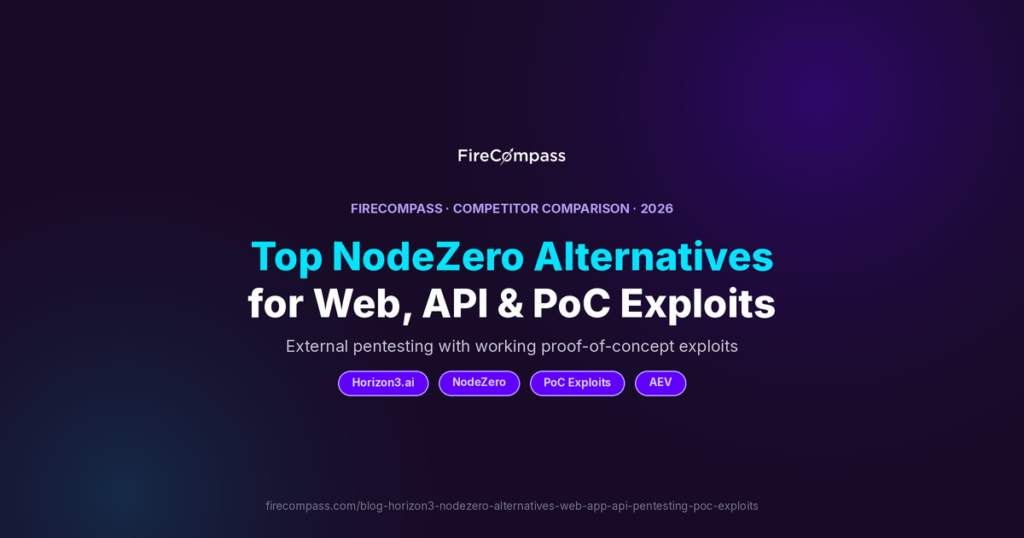
Horizon3.ai’s NodeZero built its reputation on autonomous, assumed-breach penetration testing. It chains privilege escalation paths, runs internal network assessments, and gives security teams a clear picture of what an attacker can do once they already have a foothold. For that problem, it works well.
The harder question is what happens before that foothold exists, and whether a finding comes with proof you can hand to a developer or an auditor.
NodeZero’s core architecture and pricing model are built around internal, assumed-breach testing. Horizon3 has also shipped an External Pentesting product and put a web application testing capability into Early Access, so the external and web-app story is evolving. But zero-knowledge discovery that starts from nothing but your company name, deep web application and API testing across OWASP categories, and a working proof-of-concept exploit attached to every finding are still not what NodeZero is built around first.
If your primary exposure is internal and assumed-breach scenarios, NodeZero remains a reasonable tool. If you run web applications and APIs facing the internet, and your compliance requirements demand proof of exploitability rather than a severity score, you need a platform built for that problem from the outside in.
This article covers the strongest Horizon3.ai alternatives in 2026 for teams that need external web and API coverage, zero-knowledge discovery, and working PoC exploit generation with every finding.
See your real external attack surface before you compare another pentesting tool.
Free AI Pen Test. No asset list required.
What NodeZero Doesn’t Cover
Before evaluating alternatives, it’s worth being specific about the gaps. NodeZero’s architecture and go-to-market are built primarily for internal, assumed-breach network testing. That creates a few concrete limitations worth naming.
Zero-knowledge external discovery is not the default starting point. NodeZero’s asset discovery uses DNS and OSINT to map assets you point it at, and the platform has added an external pentesting product. But a real attacker starts from your company name alone, with no asset inventory handed over. Shadow apps, staging environments, forgotten subdomains, and APIs extracted from JavaScript files are the kind of surface a purpose-built zero-knowledge discovery engine is designed to find without you already knowing it exists.
External web and API pentesting is early, not mature. Horizon3 has put a NodeZero WebApp Pentest capability into Early Access, aimed at OWASP Top 10 categories and business logic flaws like broken access control. It is not yet a generally available, deeply proven capability the way internal network pentesting is. Teams evaluating today should treat this as a roadmap item, not a shipped strength.
App-to-network chaining from the outside in is still developing. NodeZero chains findings well inside the network once it has a foothold. Its newer web application work aims to trace paths from login abuse through to host takeover, but this is Early Access. A platform built external-first, with that chaining proven in production, is a different level of maturity.
No published working PoC exploit per finding. NodeZero surfaces findings with proof of impact and remediation guidance. It does not publish a working proof-of-concept Python exploit attached to each result the way an exploit-validated platform does. When a developer pushes back on a finding, or an auditor asks for evidence of exploitability, that gap matters.
Evaluation Criteria for NodeZero Alternatives
These six criteria separate platforms that actually fill the external web and API gap from ones that mostly overlap with what NodeZero already does well internally.
- PoC exploit quality: Does every finding ship with a working exploit, steps to reproduce, and validated proof of impact?
- External web and API coverage: Does the platform test web applications and APIs as a primary capability, not an emerging add-on?
- Zero-knowledge discovery: Can the platform map your attack surface from an org name alone, without an asset list?
- Lateral movement chaining: Does the platform chain findings across apps, APIs, and network infrastructure following the MITRE ATT&CK kill chain?
- Compliance audit trail: Does the platform produce evidence that satisfies SOC 2, PCI DSS 4.0, and ISO 27001 audit requirements?
- Guardrails and governance: Can a CISO configure scope boundaries, review agent actions, and choose between autonomous and expert-in-the-loop modes?
The Top Horizon3.ai Alternatives in 2026
1. FireCompass: Best Overall for External Web, API, and PoC Exploit Generation
FireCompass is an agentic AI platform for autonomous web application and API pentesting. It is one of the more direct answers to the external coverage and PoC exploit gap, and the case rests on benchmark numbers rather than claims.
Benchmark results. FireCompass scored 104 out of 104 on the XBEN benchmark and validated 12 out of 12 findings on Acuart with working proof-of-concept exploits. It completed DVWA at all difficulty levels, fully autonomously, with no manual steering. In internal evaluations, FireCompass agents outperform top human researchers 60 to 70 percent of the time while staying under a 2 percent false positive rate.
Zero-knowledge discovery. The platform starts from your organization name. No asset list required. It maps shadow apps, forgotten subdomains, leaked credentials from the dark web, and API endpoints extracted from JavaScript files, the attack surface a real adversary sees first and one that is almost always larger than what an internal inventory shows.
Working PoC with every finding. Every validated finding ships with a working Python proof-of-concept exploit, steps to reproduce, and full context. The false positive rate sits under 2 percent, compared to the 40 to 70 percent that makes DAST tools expensive to triage. When a developer pushes back, you hand them the exploit.
Multi-stage chaining across the kill chain. FireCompass chains findings across apps, APIs, and identity into multi-stage attack paths following MITRE ATT&CK: credential reuse, app-to-app pivots, and app-to-network lateral movement into infrastructure. This starts from the external attack surface, the position a real adversary occupies first.
Testing cadence. Weekly, on-demand, or triggered by new findings. No lead time and no scheduling window to wait on.
Cost and speed. FireCompass runs about 10x faster than manual testing, roughly 1 day versus 2 or more weeks of lead time. On cost, it runs about 11x cheaper than manual pentesting, with a Fortune 500 case reducing per-app cost from around $5,000 to under $1,000. Across the platform, per-app pricing runs $450 to $2,500 versus $2,400 to $10,000 for manual engagements.
Analyst recognition. FireCompass is covered across more than 30 analyst reports from Gartner, Forrester, IDC, and GigaOm, including Gartner’s coverage of adversarial exposure validation and recognition in the Gartner Hype Cycle across 4 consecutive cycles. GigaOm named FireCompass a Leader in 2023. Security researcher and technologist Bruce Schneier serves as an advisor.
Governance. Full chain-of-thought and action logs. Configurable scope guardrails. Fully autonomous or expert-in-the-loop mode, your choice. That matters when you are running tests against production web applications and need a CISO to approve scope before the agents start.
The free entry point is the Explorer tool at firecompass.com/explorer, which builds a real external attack surface map from your org name at no cost.
2. Pentera: Strong Internal Network Coverage, External Add-On
Pentera runs automated internal network penetration testing with attack simulation across Active Directory and on-premises infrastructure, paired with an external attack surface management layer for outside-in visibility. It chains findings well inside the network perimeter and produces solid remediation evidence.
The gap for teams chasing external web and API coverage is depth. Pentera’s external capability is positioned as attack surface management alongside its internal pentesting core, not a purpose-built external web application and API testing engine. If your primary risk is internal lateral movement, Pentera is a credible tool. If you need deep external web and API testing with PoC exploits, it does not fully close that gap.
3. Picus Security: BAS-Focused, Not a Pentest Replacement
Picus Security is a Breach and Attack Simulation platform with an added Attack Path Validation module. It validates whether your security controls detect and block known attack techniques, and increasingly tests internal attack paths, which is a different problem from finding exploitable vulnerabilities in your web applications and APIs.
Picus is useful for control validation and detection engineering. It is not primarily a web application penetration testing platform. It does not run zero-knowledge external discovery from an org name, and its web application coverage is not built around generating a working PoC exploit for every application finding. If you are looking for a NodeZero alternative that tests web applications and produces exploit evidence, Picus solves an adjacent problem, not the same one.
Worth noting: Picus published a “Best Alternatives to Horizon3” article in 2026 naming Picus and Pentera as the two alternatives it recommends. FireCompass is not mentioned. Given FireCompass’s benchmark results and analyst coverage, that reads as a gap in the comparison rather than a reflection of category fit.
4. Cymulate: Exposure Validation with BAS Roots
Cymulate combines attack surface management, BAS, and some penetration testing capabilities. It covers a broad range of attack simulations and has added external attack surface features over time.
The limitation for teams evaluating NodeZero alternatives is depth. Cymulate’s application testing does not match the PoC exploit quality or zero-knowledge discovery depth of a purpose-built web application pentesting platform. It does not attach a working Python exploit to every finding. Multi-stage chaining across apps, APIs, and network infrastructure is not equivalent to a full MITRE ATT&CK kill chain starting from the external perimeter.
For teams that want a single platform to cover external web and API testing, Cymulate leaves meaningful gaps.
5. NetSPI: Manual Pentest Firm with a Platform Layer
NetSPI is a penetration testing firm that has built a platform layer called Resolve to manage findings and track remediation. It is a credible manual testing provider with deep expertise.
The tradeoff is structural. Manual pentests run on a schedule, with lead times commonly running two to four weeks. Testing is point-in-time, not continuous. You get depth from experienced testers, but not weekly or on-demand cadence, and not automated zero-knowledge discovery running between engagements. Manual engagement pricing also runs well above what an automated per-app model costs, which limits how far the budget stretches across a large application portfolio.
NetSPI is a reasonable choice for compliance-driven annual testing or high-stakes assessments where human judgment matters throughout. It is not a replacement for continuous automated coverage.
6. Cobalt: PTaaS with a Crowdsourced Researcher Model
Cobalt runs a Pentest as a Service model using a network of vetted security researchers. You scope an engagement, researchers test it, and findings come back through a management platform.
The model produces good results for scoped web application testing. The constraints are familiar: lead time to start, point-in-time coverage rather than continuous, and cost that scales with scope and platform fees. Cobalt does not run zero-knowledge discovery before an engagement starts. It does not chain findings across apps and network infrastructure automatically. PoC quality depends on the researcher assigned.
For teams that want human creativity in testing and are comfortable with a managed service model, Cobalt is a reasonable option. For teams that need continuous coverage and automated PoC generation at scale, the model does not keep pace.
Side-by-Side Comparison
| Capability | FireCompass | NodeZero | Pentera | Picus | Cymulate | NetSPI | Cobalt |
|---|---|---|---|---|---|---|---|
| Zero-knowledge external discovery | Yes | Limited | Partial | No | Partial | No | No |
| External web and API pentesting | Yes | Early Access | Limited | No | Partial | Yes | Yes |
| Working PoC exploit per finding | Yes | No | No | No | No | Yes (manual) | Yes (manual) |
| App-to-network lateral movement chaining | Yes | Internal-first, external emerging | Internal only | No | Limited | No | No |
| MITRE ATT&CK full kill chain | Yes | Partial | Partial | Yes | Partial | Partial | Partial |
| Continuous / on-demand cadence | Yes | Yes | Yes | Yes | Yes | No | No |
| Compliance audit trail | Yes | Yes | Yes | Yes | Yes | Yes | Yes |
| Configurable scope guardrails | Yes | Yes | Yes | N/A | Yes | N/A | N/A |
| False positive rate | Under 2% | Not published | Not published | N/A | Not published | Low (manual) | Low (manual) |
How to Choose
If your primary gap is internal network coverage and Active Directory attack paths, NodeZero and Pentera both address that well. Neither is the wrong tool for that specific problem.
If your primary gap is external web and API coverage, zero-knowledge discovery, and working exploit evidence, you need a platform built for exactly that from the outside in. The criteria that matter most are PoC exploit quality, zero-knowledge discovery depth, and multi-stage chaining across the full kill chain.
FireCompass is built to satisfy all six evaluation criteria at once, with public benchmark proof behind it: 104 out of 104 on XBEN, under 2 percent false positives, and a working Python exploit shipped with every finding.
To see what your external attack surface actually looks like before an adversary does, the Explorer tool at firecompass.com/explorer builds a real attack surface map from your org name at no cost. No asset list required.
Governance & Safety
Continuous only works if it is safe to run in production.
Scope enforcement, production-safe execution, a forensic audit trail, and kill switches on every engagement.
Frequently Asked Questions
What is the main difference between Horizon3 NodeZero and FireCompass?
NodeZero is built primarily around internal, assumed-breach network penetration testing, with an external pentesting product and a web application testing capability now in Early Access. FireCompass starts from your organization name alone, discovers the external attack surface including shadow apps and forgotten subdomains, runs authenticated and unauthenticated web and API testing, and chains findings across apps, APIs, and network infrastructure following the MITRE ATT&CK kill chain. Every validated finding ships with a working Python proof-of-concept exploit.
Which NodeZero alternatives generate working proof-of-concept exploits?
FireCompass generates a working Python PoC exploit for every validated finding, along with steps to reproduce and full context. Manual providers like NetSPI and Cobalt also produce PoC evidence, but through human researchers on a scheduled basis rather than continuously. Pentera, Picus, and Cymulate do not attach working application exploits to individual findings in the same way.
Does FireCompass require an asset list before testing begins?
No. FireCompass starts from your organization name and maps the external attack surface from a zero-knowledge position, the same starting point a real adversary uses. It discovers shadow apps, forgotten subdomains, API endpoints extracted from JavaScript files, and leaked credentials from the dark web without requiring an asset inventory upfront.
How does FireCompass handle multi-stage attack chaining compared to NodeZero?
FireCompass chains findings across web applications, APIs, and identity into multi-stage attack paths following MITRE ATT&CK, including credential reuse, app-to-app pivots, and app-to-network lateral movement into infrastructure. NodeZero chains findings well inside the internal network; its ability to chain from an external, zero-knowledge starting point through web applications is a newer, Early Access capability.
Is FireCompass suitable for compliance requirements like PCI DSS 4.0 and SOC 2?
Yes. FireCompass produces a full audit trail with chain-of-thought and action logs for every agent action. The continuous testing cadence and exploit-validated findings support SOC 2, PCI DSS 4.0, and ISO 27001 audit requirements. Testing can run on weekly, on-demand, or trigger-based schedules to match the frequency compliance frameworks increasingly require.
How does FireCompass compare to Picus Security for web application testing?
Picus is a Breach and Attack Simulation platform focused on validating whether your security controls detect known attack techniques, a different category from penetration testing. Picus does not run zero-knowledge external discovery and does not generate working PoC exploits for application vulnerabilities the way an exploit-validated pentesting platform does. FireCompass runs the exploit. Picus validates whether your controls would have caught it.
What is the false positive rate for FireCompass compared to DAST tools?
FireCompass maintains a false positive rate under 2 percent. DAST tools and scanners typically produce false positive rates of 40 to 70 percent, which means teams spend significant time triaging findings that turn out to be non-issues. FireCompass validates exploitability before surfacing a finding, which is why the rate is low and why every finding comes with a working exploit rather than a theoretical alert.
GARTNER is a registered trademark and service mark of Gartner, Inc. and/or its affiliates in the U.S. and internationally and are used herein with permission. All rights reserved. Gartner does not endorse any vendor, product or service depicted in its research publications, and does not advise technology users to select only those vendors with the highest ratings or other designation. Gartner research publications consist of the opinions of Gartner’s research organization and should not be construed as statements of fact. Gartner disclaims all warranties, express or implied, with respect to this research, including any warranties of merchantability or fitness for a particular purpose.