
AI Penetration Testing that proves what attackers can exploit.
FireCompass AI agents discover your attack surface, run web and API pentests, and chain findings into real attack paths. Every finding ships with a working exploit. Under 2% false positives.
What is AI penetration testing?
AI penetration testing uses autonomous AI agents to plan, execute, and validate attacks against applications and infrastructure. Unlike scanners that only flag vulnerabilities, AI agents exploit them, prove impact with a working proof of exploit, and chain findings into multi-stage attack paths, running continuously at a fraction of the cost of manual testing.
Annual pentesting was built for software that shipped once a quarter.
That world is gone. Teams deploy weekly or daily, and attackers now move at machine speed. Three structural gaps open the moment testing runs on a calendar.
Tested vs attacked
Most programs test crown-jewel apps and leave shadow apps, forgotten subdomains, and API endpoints untouched. Attackers probe 100% of the surface.
Scanner false positives
Scanners flag issues in isolation. Real attackers chain them. 22% of breaches start with credential abuse, and 20% begin through a peripheral asset.
vs a 3-day exploit window
Many teams still test once a year. Attackers exploit new CVEs in about 3 days. The gap widens with every release you ship.
Four capabilities, each tied to a trigger.
A change happens, a test fires. No scheduling, no human in the critical path.
Discover the surface attackers actually see
Build your real attack surface from your name alone, so testing covers what attackers can actually reach.
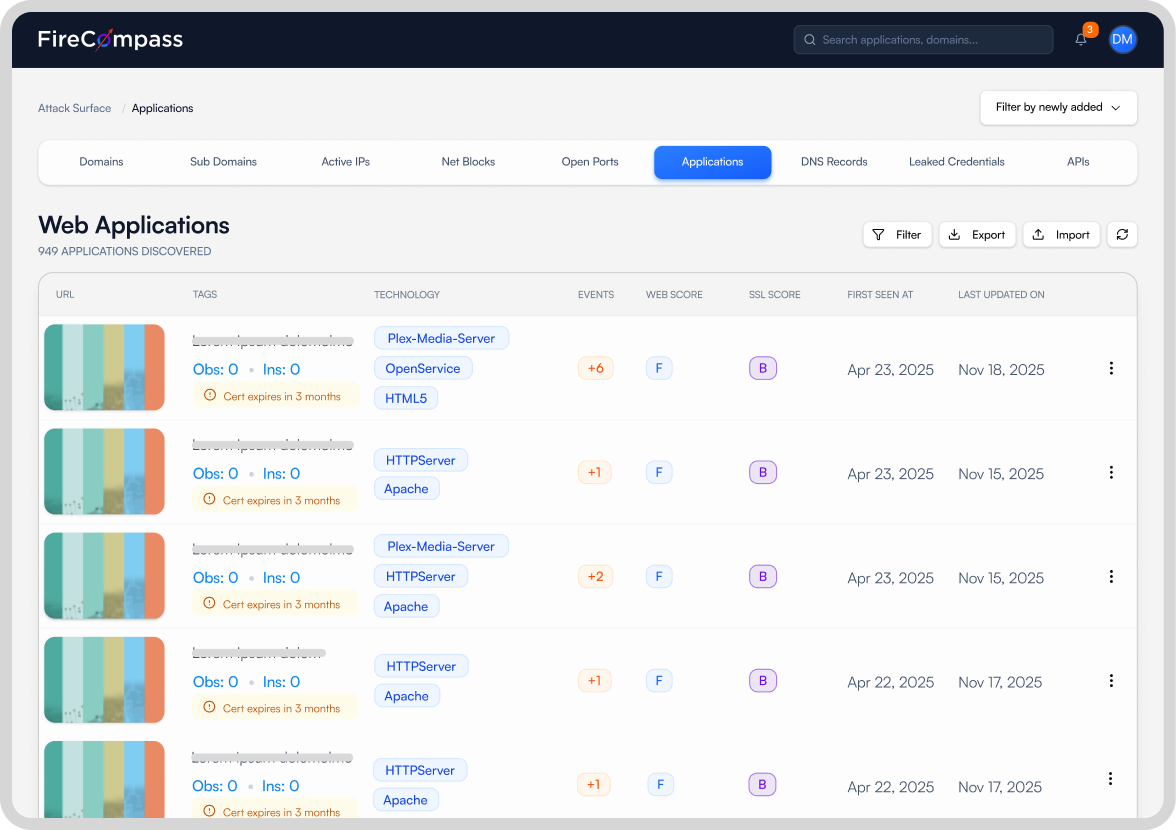
- Shadow apps and forgotten subdomains surfaced from your name alone.
- Leaked credentials on the deep and dark web.
- API endpoints pulled from JS files and traffic.
- Visibility scales from about 20% to over 99% of the surface.
Pentest with proof, not noise
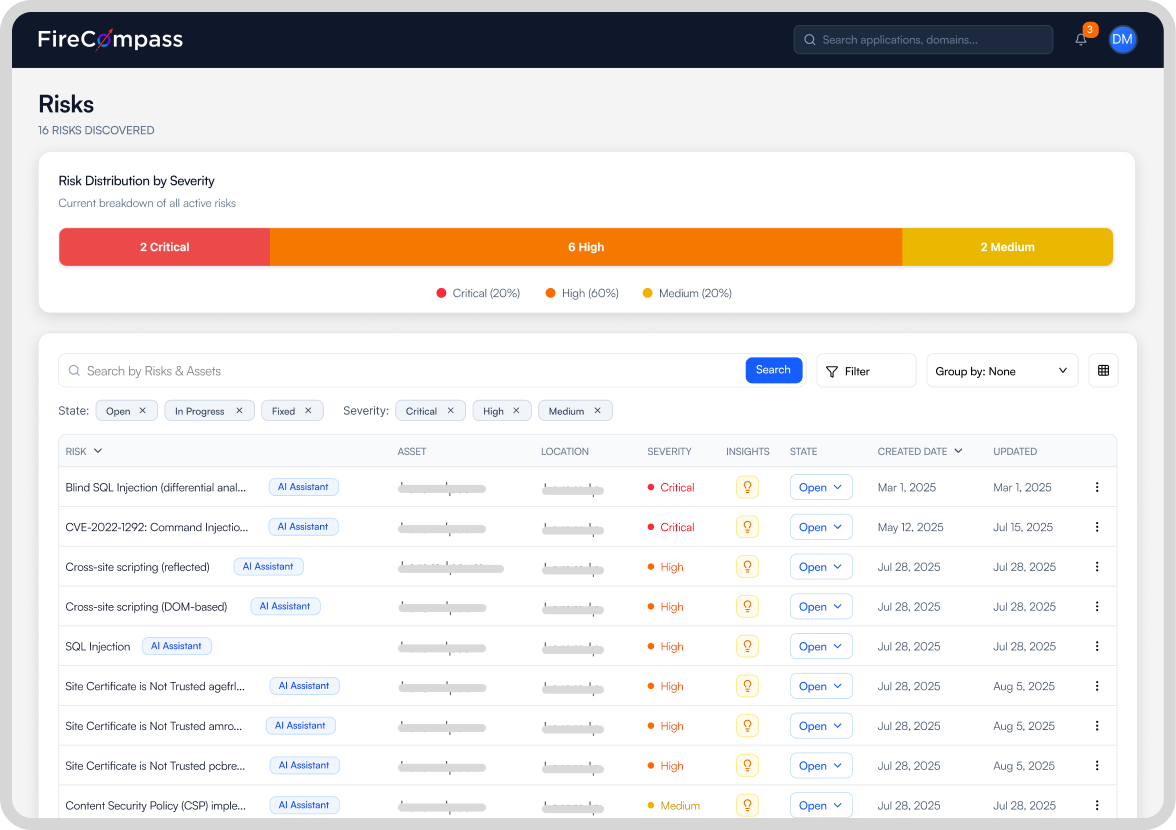
Agents test like an attacker and confirm what is real, so your team triages exploitable findings, not false alarms.
- OWASP Top 10: 2025 plus business logic testing.
- Authenticated and unauthenticated paths, including MFA flows.
- Credential abuse and authorization testing.
- Every finding ships proof of exploit, steps to reproduce, and ready-to-run Python.
Chain findings into real attack paths
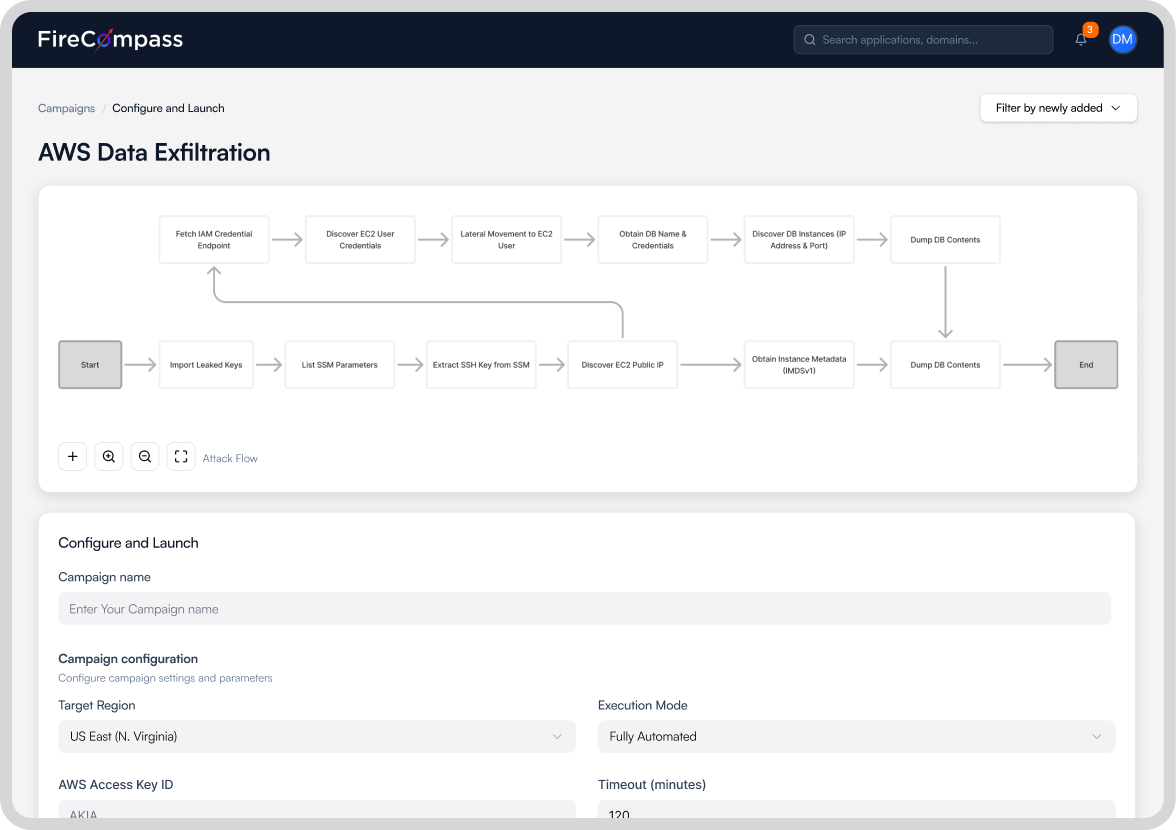
A single finding is rarely the breach. Agents connect findings the way real adversaries do in multi-stage red teaming, showing true blast radius.
- Credential reuse across services.
- App-to-app and app-to-network lateral movement.
- Privilege escalation path discovery.
- Full MITRE ATT&CK kill-chain automation, no human steering.
Run on your cadence, not a calendar
Testing keeps pace with how fast you ship, so the window between a change and its validation closes to near zero.
- Weekly, on demand, or aligned to CI/CD.
- Day-1 CVE validation for new disclosures.
- One-click revalidation to confirm fixes.
- Agentless and operational in minutes.
A scanner lists vulnerabilities. FireCompass shows the path an attacker actually walks.
Three real chains the agents validated end to end. This is what isolated findings miss.
UAT to production via an exposed auth token
- Auth token found in a .js file
- Base64 decoded
- Accessed restricted endpoints
- Same credentials worked on production
WAF bypass via origin server discovery
- WAF blocked the request (403)
- Recon revealed the origin IP
- Payloads sent directly to origin
- WAF fully bypassed
Web app to network lateral movement
- Exposed .git directory
- Database credentials extracted
- Credential reuse, then SSH root
- Database exfiltrated
No human steering. No predefined playbook. Agents beat our top researchers 60 to 70% of the time in internal evals.
Run an AI pen test against your own attack surface.
Start free, or connect with a FireCompass expert. In one session you will:
- ✓See shadow apps, subdomains, and exposed APIs discovered from your name alone.
- ✓Watch an agent validate a real finding with a working proof-of-concept exploit.
- ✓Set the triggers that fire a test on every deploy, new asset, and fresh CVE.
Exploit-validated findings, benchmarked in the open.
Every finding ships proof
- ✓Working proof of exploit for every reported vulnerability.
- ✓Steps to reproduce plus ready-to-run Python.
- ✓Mapped to OWASP Top 10: 2025 with business impact and severity.
- ✓Under 2% false positives, so the team triages real risk, not noise.
Fortune 500: annual program to continuous
Before → AfterStart with agentic pen testing. Expand to full red teaming and CTEM.
One platform covering PTaaS, automated red teaming, attack surface management, and continuous threat exposure management.
Web & API automated pen testing
Authenticated and unauthenticated testing, business logic, and proof-of-exploit.
Infrastructure pen testing
Networks, servers, and cloud, continuously validated.
Continuous Automated Red Teaming (CART)
MITRE ATT&CK-aligned attack trees, lateral movement, and privilege escalation.
Pen testing as a service (PTaaS)
Expert-in-the-loop for business logic and compliance acceptance.
CTEM and attack surface management (ASM)
Continuous exposure monitoring and risk prioritization.
SaaS or internal testing
SaaS in minutes for external testing. Internal appliance in under one hour.
Most "AI pentest" tools solve one gap and ignore the other two.
Continuous DAST gives speed without depth. PTaaS gives depth without scope or cadence. ASM gives scope without validation. Point-and-shoot AI hits one target. FireCompass does all of it, with every exploit proven.
| Capability | Continuous DAST | Human-led PTaaS | Continuous ASM | Point-and-shoot AI | FireCompass |
|---|---|---|---|---|---|
| Full attack-surface scope | Partial | Scoped slice | Yes | Single target | Yes |
| Business-logic depth | No | Manual | No | Limited | AI-driven |
| Multi-stage attack chains | No | Manual | No | Single-shot | Autonomous |
| Exploit-validated PoC | No | Yes | No | Yes | Every finding |
| Trigger-driven cadence | Yes | Weeks | Yes | Manual | On every change |
| Cost per app | $1,460–$2,900 | $2,400–$10,000 | Low | Varies | $450–$2,500 |
| False positive rate | up to 70% | Variable | High | Variable | Under 2% |
| Governance & audit trail | Partial | Manual | Partial | Limited | Built in |
Autonomous only works if it is safe to run in production.
A leading global research firm notes that the governance layer is the part the market underestimates most. It is where we built first.
- ✓Scope enforcement. Agents act only within defined boundaries. Nothing tests outside the authorized surface.
- ✓Production-safe execution. Rate limits and control gates keep live systems stable while testing runs.
- ✓Forensic audit trail. Every command, request, and response is timestamped for non-repudiation and review.
- ✓Human-in-the-loop, optional. Run fully autonomous, or keep an expert validating before action.
- ✓Kill switches. Stop any engagement instantly. Control over what agents can and cannot do is the design principle.
Validated by the analysts who define the category.
Listed in "The Future of Pen Testing Is Continuous Offensive Security Testing" (ID G00845606).
XBEN 104/104, Acuart 12/12 PoC-validated, and DVWA, fully autonomous with no human hints.
Across Forrester, IDC, GigaOm and a leading gloabl research firm. GigaOm Leader, 2023. On the Hype Cycle four cycles running.
AI penetration testing, answered.
What is AI penetration testing?
How accurate is AI penetration testing?
Can AI replace manual penetration testing?
How is agentic AI pentesting different from a DAST scanner?
Is it safe to run against production?
How fast does a test run, and what does it cost?
For security professionals
Run your first AI-driven web and API pentest this week. No install, results in about a day.
Free AI Pen Test →