Home
Home


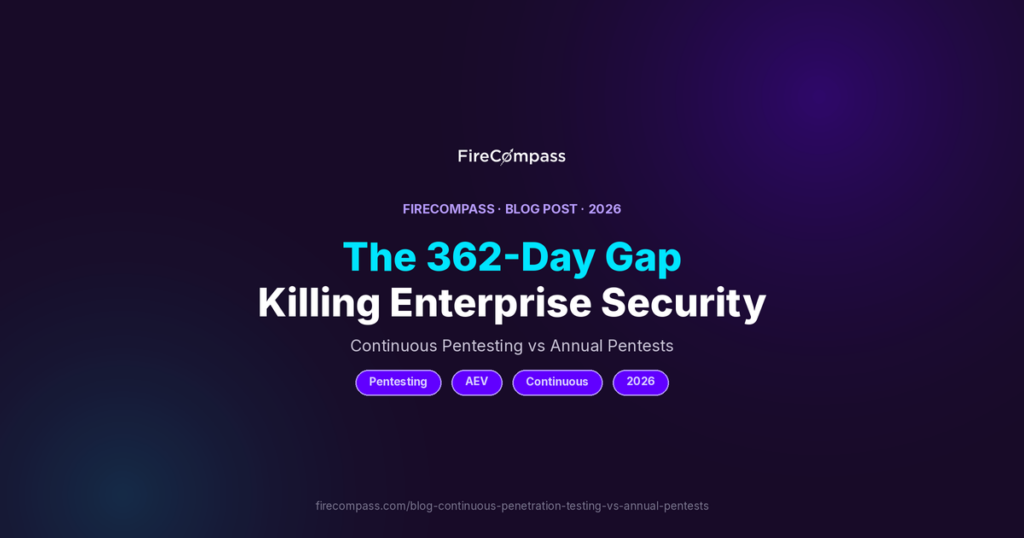
Your annual pentest finished three weeks ago. Somewhere on your external attack surface, a forgotten subdomain is running an unpatched service. While organizations take months to patch, adversaries are now exploiting newly discovered vulnerabilities within days and, increasingly, hours or less. Your next scheduled test is eleven months away.
That gap is 362 days. It is not a theoretical risk. It is the window real attackers operate in.
See how much of your attack surface a 362-day testing gap is actually leaving exposed.
Free AI Pen Test. No asset list required.
The Annual Pentest Was Built for a Different Era
Annual penetration testing made sense when attack surfaces were relatively stable, compliance calendars drove security programs, and the cost of more frequent testing was genuinely prohibitive. None of those conditions hold in 2026.
Your attack surface changes every time a developer ships a new API endpoint, spins up a cloud instance, or integrates a third-party service. Shadow apps appear without your knowledge. Subdomains get forgotten. Credentials leak onto dark web forums. The surface you tested in January is not the surface you are running in December.
Meanwhile, adversaries are not waiting for your audit cycle. Published CVEs get weaponized in days, sometimes hours. Automated scanning tools make it trivial to probe thousands of targets for known weaknesses. The attacker’s cadence is continuous. Yours, if you rely on annual testing, is not.
The compliance argument for annual testing is also weakening. PCI DSS 4.0 tightened its requirements around testing frequency and scope. SOC 2 auditors increasingly ask about cadence. ISO 27001 expects controls to match the actual threat environment. A once-a-year report is harder to defend when the question is “what was your exposure last Tuesday?”
What Continuous Penetration Testing Actually Means
The term gets used loosely, so it is worth being precise. Continuous penetration testing is not scheduled scanning on a shorter interval. It is not running a DAST tool weekly and calling it a pentest. It is not detection-gap analysis bolted onto a SIEM.
Real continuous penetration testing means:
- Active discovery of your full external attack surface, including assets you did not know existed
- Exploit-validated findings with working proof-of-concept code, not a list of CVEs that may or may not be reachable
- Multi-stage attack path chaining that mirrors how real adversaries move, from initial access through lateral movement to impact
- Continuous cadence that runs daily, weekly, or on-demand, not on a calendar set twelve months in advance
The distinction between a scanner and a continuous pentest platform is the difference between a list and a proof. A scanner tells you a vulnerability exists. A continuous pentest platform tells you it is exploitable, shows you the steps to reproduce it, and attaches working code to confirm it.
The 362-Day Gap in Practice
Consider a realistic scenario. Your annual pentest covers the assets your team scoped and handed to the vendor. It runs for two to three weeks. You get a report. Your team remediates the critical findings over the next month or two. Then the clock resets.
In the eleven months that follow, your developers ship dozens of new features. A marketing team member spins up a subdomain for a campaign and forgets to take it down. An acquired company’s legacy API gets connected to your main environment. A contractor’s credentials appear in a breach dump.
None of that gets tested until next year’s engagement. And if an attacker finds any of it, they have months to move.
The math is straightforward. If a CVE gets exploited in about 3 days on average, and your testing window is 362 days wide, you are relying on luck for most of the year.
Why “More Frequent Scans” Does Not Close the Gap
The instinct is to add more scanning. Run your DAST tool weekly. Add an ASM platform to track inventory. Buy a threat intelligence feed.
These tools have real value. ASM gives you visibility into what exists. Threat intelligence tells you what is being targeted. DAST identifies known vulnerability patterns.
But none of them prove exploitability. DAST tools generate false positive rates of 40 to 70 percent, which means your team spends significant time triaging findings that turn out to be noise. ASM tells you a subdomain exists; it does not tell you whether it is exploitable or what an attacker could reach from it. Threat intelligence identifies categories of risk; it does not chain a web app finding into network lateral movement and show you the blast radius.
The gap between visibility and proof is where breaches happen.
Gartner’s View on Adversarial Exposure Validation
Gartner’s coverage of adversarial exposure validation (AEV) reflects a category that consolidates breach-and-attack simulation, automated penetration testing, and red teaming under a single framework.
The framing matters. Adversarial exposure validation is not a rebranding exercise. It reflects a shift in how security programs measure risk: not by whether controls exist, but by whether those controls actually stop an adversary from reaching a target. The question is no longer “do we have a WAF?” It is “can an attacker get past our WAF, pivot to the internal API, and reach the database?”
That is a pentest question. And it requires a continuous answer.
What Multi-Stage Chaining Changes
Most point-in-time pentests and many automated tools stop at the application boundary. They find a vulnerability in a web app, confirm it is exploitable, and report it. That is useful. It is not complete.
Real attackers chain findings. They find a misconfigured subdomain, use it to harvest credentials, reuse those credentials across services (T1078 in MITRE ATT&CK), pivot from the web app to an internal API, and then move laterally toward higher-value targets. The individual findings may each look low-to-medium severity. The chained path is critical.
Continuous penetration testing platforms that stop at the app boundary miss this entirely. The finding that looks like a medium-severity IDOR on its own becomes a path to your database when chained with a credential reuse vulnerability two hops away.
This is why the architecture of a continuous testing platform matters as much as the cadence. Discovery, exploit validation, and multi-stage chaining have to work together. Running more frequent single-target tests does not replicate what an adversary actually does.
The Compliance Angle
If your security program is subject to PCI DSS 4.0, SOC 2, or ISO 27001, continuous penetration testing is not just a security improvement. It is increasingly a compliance requirement or at minimum a compliance accelerant.
PCI DSS 4.0 requires penetration testing at least annually and after significant infrastructure or application changes. “Significant changes” in a modern development environment can mean dozens of deployments per month. An annual test does not satisfy the spirit of that requirement even if it satisfies the letter.
Continuous testing generates an ongoing audit trail. Every finding, every exploit, every remediation verification is logged. When your auditor asks about testing cadence, you have evidence that covers the full year, not a report from a two-week engagement ten months ago.
What to Ask Any Continuous Testing Vendor
The market is crowded and the terminology is loose. Before evaluating any platform, ask these questions:
1. Do you discover shadow assets and unknown apps, or only test targets I hand you? If the answer is “you provide the scope,” it is not continuous penetration testing. It is automated testing on a known list.
2. Can you chain a web app finding into network lateral movement? If the platform stops at the app boundary, it does not replicate adversary behavior.
3. What are your public benchmark scores and false positive rate? Vague claims about accuracy are not proof. Ask for specific numbers on specific benchmarks.
4. What controls and audit trail do you provide? Can you see exactly what the agent did? Can you limit what it touches in production?
5. Where do you appear in analyst coverage? A vendor with a multi-year Gartner Hype Cycle trail is a different risk profile from one that launched twelve months ago.
How FireCompass Closes the Gap
FireCompass is an agentic AI platform for autonomous web app and API penetration testing, built for continuous coverage. Starting from just an org name, it maps your full external attack surface, including shadow apps, forgotten subdomains, API endpoints pulled from JavaScript files, and leaked credentials on the dark web.
From there, it runs exploit-validated tests aligned to OWASP Top 10 2025, attaches working Python proof-of-concept code to every finding, and chains results into multi-stage attack paths across the MITRE ATT&CK kill chain. False positives stay under 2 percent, compared to 40 to 70 percent for DAST scanners. On public benchmarks, it scored 104/104 on XBEN and 12/12 on Acuart, with PoC validation on every result, fully autonomous with no manual steering.
In internal evaluation, FireCompass agents beat top human researchers 60 to 70 percent of the time, while staying under 2 percent false positives. It runs about 10x faster than manual testing (1 day vs 2+ weeks lead time) and about 11x cheaper, scaling from 200 to 2,000+ apps and pushing coverage from roughly 10 percent to 99 percent of the attack surface.
The platform has appeared in Gartner Hype Cycle recognition for 4 cycles running, is named across 30+ analyst reports from Gartner, Forrester, IDC, and GigaOm, and was named a GigaOm Leader in 2023. Bruce Schneier serves as an advisor. It runs fully autonomous or expert-in-the-loop, with full chain-of-thought logging and configurable scope guardrails so your team controls exactly what the agents can touch.
Annual pentests leave a 362-day window. Continuous penetration testing closes it.
GARTNER is a registered trademark and service mark of Gartner, Inc. and/or its affiliates in the U.S. and internationally and are used herein with permission. All rights reserved. Gartner does not endorse any vendor, product or service depicted in its research publications, and does not advise technology users to select only those vendors with the highest ratings or other designation. Gartner research publications consist of the opinions of Gartner’s research organization and should not be construed as statements of fact. Gartner disclaims all warranties, express or implied, with respect to this research, including any warranties of merchantability or fitness for a particular purpose.
Governance & Safety
Continuous only works if it is safe to run in production.
Scope enforcement, production-safe execution, a forensic audit trail, and kill switches on every engagement.
FAQs
What is continuous penetration testing?
Continuous penetration testing is an automated, ongoing security testing approach that actively discovers your attack surface, validates exploitable vulnerabilities with working proof-of-concept code, and chains findings into multi-stage attack paths. Unlike annual pentests that run once on a fixed scope, continuous testing runs daily or weekly and adapts as your environment changes.
How is continuous penetration testing different from a DAST scanner?
DAST scanners identify known vulnerability patterns but do not validate exploitability. They produce false positive rates of 40 to 70 percent and stop at the application boundary. Continuous penetration testing runs actual exploits, attaches proof-of-concept code to every confirmed finding, and chains results across apps, APIs, and network layers to show real attack paths.
What is the 362-day gap?
The 362-day gap refers to the period between annual penetration tests during which your attack surface is untested. Since adversaries now exploit newly discovered vulnerabilities within days and increasingly, hours or less, an annual testing cadence leaves nearly the entire year as an unvalidated window. Continuous penetration testing eliminates this gap by running on a daily or weekly cadence.
Does continuous penetration testing satisfy PCI DSS 4.0 and SOC 2 requirements?
Continuous testing generates an ongoing audit trail that supports PCI DSS 4.0, SOC 2, and ISO 27001 requirements. PCI DSS 4.0 requires testing after significant infrastructure or application changes, which in modern development environments can mean many deployments per month. Continuous testing ensures those changes are validated in near real time, not eleven months later.
What is adversarial exposure validation?
Adversarial exposure validation (AEV) is a category in Gartner’s coverage that consolidates breach-and-attack simulation, automated penetration testing, and red teaming under a unified framework. It measures security posture by whether controls actually stop an adversary from reaching a target, not just whether controls exist.
What should I look for in a continuous penetration testing platform?
Look for platforms that discover unknown assets rather than only testing what you provide, validate findings with working exploits rather than generating CVE lists, chain findings across the full MITRE ATT&CK kill chain, maintain false positive rates under 2 percent, provide full audit trails for compliance, and have verifiable public benchmark results and analyst recognition.
How does agentic AI improve penetration testing?
Agentic AI enables penetration testing agents to autonomously discover assets, select and execute attack techniques, chain findings into multi-stage paths, and adapt based on what they find, all without human direction at each step. This mirrors how real adversaries operate and allows testing to run continuously at machine speed rather than being limited to scheduled human-led engagements.