Home
Home


Early January, I published a deep dive into why we ripped out JSON-RPC and rewrote our Model Context Protocol (MCP) server using gRPC for our internal AI initiatives. The idea was simple: if you are building enterprise-grade agents, you cannot rely on the “guesswork” of dynamic JSON payloads. You need the strict guarantees of Protobufs.
Shortly after, Google Cloud published a blog post validating this exact architectural shift, announcing their commitment to supporting gRPC as a native transport for MCP. And the momentum hasn’t stopped there.
It is incredibly rewarding to see industry leaders reach the exact same engineering conclusions we did at the FireCompass Research Initiative. Here is a look at how this shift is playing out across the ecosystem, how our architecture aligns with Google’s vision, and the real-world benchmarks we’ve seen since making the switch.
The Timeline of a Protocol Shift
The move from stateless JSON to streaming gRPC for the AI context wasn’t just a random idea; it has become an industry-wide realization occurring over just a few months.
- The FireCompass Rewrite (9th January 2026): We realized that the fact that standard MCP wasn’t robust enough for the strict, enterprise-grade demands of Switchblade, our automated cybersecurity pentesting agent. We successfully replaced JSON-RPC with gRPC, establishing strict Protobuf schemas for our local LLM client.
- Google Cloud’s Validation (14th January 2026): Google Cloud officially published their engineering blog, announcing they are actively working with the community to support gRPC as a custom, native transport for MCP. Their rationale—enterprise security, polyglot development, and efficiency—mirrored our own findings.
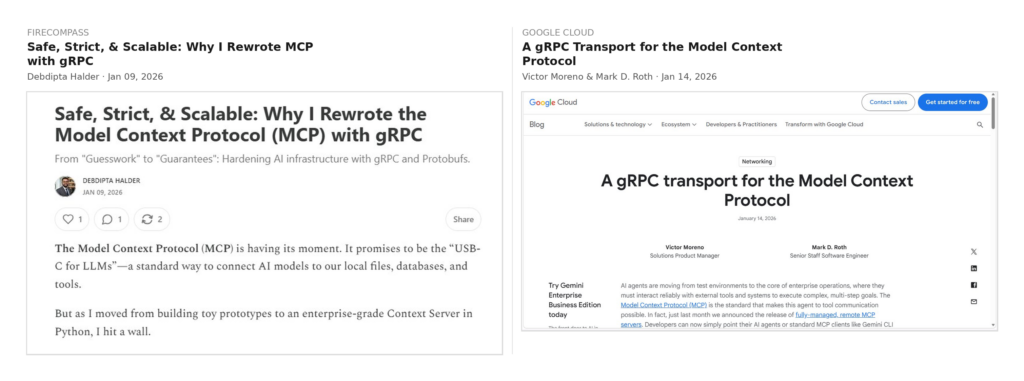
Figure 1: A side-by-side screenshot of the published FireCompass blog post (left) and Google Cloud’s blog post (right).
The Gaps in Standard MCP (And Why We Had to Move)
While standard MCP is fantastic for getting the ecosystem started, its reliance on JSON-RPC creates several critical vulnerabilities and bottlenecks when deployed in enterprise or security-sensitive environments.
- The Security Gap: MitM and Context Injection. In standard MCP, remote connections often rely on basic HTTP without native mutual authentication. We have already seen this exploited in the wild. Recent supply-chain attacks have demonstrated how an adversary can use a Man-in-the-Middle (MitM) proxy to intercept an MCP connection and steal bearer tokens without the user noticing. Furthermore, JSON’s dynamic typing leaves the door open for “Type Confusion” and context injection attacks, where a malicious payload easily tricks the LLM into executing unintended commands.
- The gRPC Fix: gRPC treats security as a first-class citizen. It natively supports Mutual TLS (mTLS) and token-based authentication (JWT/OAuth), ensuring that both the AI agent and the external tool cryptographically verify each other before a single byte of context is shared. This effectively shuts down MitM attacks. Additionally, Protobufs enforce strict schemas, rejecting malicious, injected, or malformed payloads instantly at the serialization layer.
- The Cost and Compute Gap Parsing JSON at the scale of massive LLM context windows is incredibly expensive. Stringifying and deserializing complex agentic state representations or large data repositories burns unnecessary CPU cycles and memory. At an enterprise scale, this transport-layer overhead translates directly into inflated cloud compute costs and latency bottlenecks.
- The gRPC Fix: By moving to a binary encoding format, message sizes shrink dramatically (up to 10x smaller). This drastically reduces bandwidth costs and frees up CPU and memory, allowing your infrastructure budget to go toward actual machine learning workloads rather than just parsing text.
- The Resiliency Gap LLMs operate at blistering speeds, but the external tools they interact with often don’t. JSON-RPC lacks built-in mechanisms to handle an overwhelmed system. If a database query hangs or if an agent rapidly spams tool requests, standard MCP struggles to manage the traffic, which can easily lead to cascading system failures.
- The gRPC Fix: gRPC is built for massive, distributed systems. It includes native flow control (backpressure), deadlines, and timeouts. If a tool takes too long to respond, the gRPC framework automatically cancels the request based on your predefined policy, ensuring the agentic loop never hangs.
The Architectural Alignment
Google Cloud’s recent engineering publication closely mirrors the architectural foundation of Switchblade, our high-performance, proprietary MCP service built for secure internal chatbot integrations. Reaching these identical core principles independently underscores a clear industry consensus on how to build robust, enterprise-grade agentic infrastructure.
The FireCompass Architecture
In our setup for Switchblade, the LLM is isolated as a pure planner. It communicates with the tool registry and execution environment strictly through a gRPC server. Because we are executing cybersecurity workflows where a hallucinated or malformed command could be catastrophic, every input and output must pass through a rigid .proto contract. Furthermore, we leverage gRPC’s bidirectional streaming to maintain a persistent connection, allowing the environment to push real-time threat updates back to the agent without waiting for the agent to poll for them.
The Google Cloud Architecture
Google’s proposed architecture approaches MCP from a massive-scale infrastructure perspective. They emphasize using gRPC to avoid the latency and complexity of deploying transcoding gateways (which translate JSON-RPC to existing gRPC enterprise services). They also highlight integrating industry-standard token-based authentication (JWT/OAuth) natively into the gRPC layer to provide verifiable identities for AI agents.
Why They Align
Whether you are building a specialized pentesting agent running on a local LLM or deploying enterprise services at Google’s scale, the fundamental truth remains the same: schema-first security and full-duplex bidirectional streaming are non-negotiable for production AI. Both architectures recognize that standard HTTP/JSON polling is insufficient for real-time agentic workflows.
FireCompass Implementation: The Results
The theoretical benefits of gRPC are well-documented, but the practical impact on our internal Switchblade framework was immediate and measurable. When we benchmarked our new gRPC MCP server against the original JSON-RPC implementation, the performance gains were staggering:
- Payload Efficiency (75%+ Reduction): By stripping away the heavy stringification of JSON and transitioning to binary encoding via Protobufs, our average message size shrank by nearly 75%. This dramatically reduced our memory overhead during extended context sessions.
- Latency Reduction (~3x Faster): Because the binary payload is lighter and doesn’t require complex parsing or validation logic on the server side, tool execution round-trip times dropped significantly. The agent can now complete multi-step reasoning and execution loops without bottlenecking on the transport layer.
- Zero Type-Confusion Errors: In our previous JSON implementation, malformed tool calls from the LLM would occasionally crash the execution layer. Since moving to Protobufs, these errors have dropped to zero. If the LLM hallucinates a parameter, the gRPC interface instantly rejects it at the gate, prompting the agent to self-correct before any code is executed.
What Lies Ahead for Agent Infrastructure
Standard MCP got the ecosystem off the ground, but for infrastructure that touches sensitive data, “good enough” is officially deprecated.
Having Google Cloud actively contribute a gRPC transport package to the MCP SDK means that the wider developer community won’t have to build custom servers from scratch to get these enterprise benefits. NVIDIA and F5 stepping in proves that securing these MCP servers at the edge is the next massive frontier.
We were a few days early to the party, but the industry has officially arrived. The era of “chatting with files” is over. The era of robust, statically typed autonomous agents is here.
About FireCompass
FireCompass is an Agentic AI platform for autonomous penetration testing and red teaming across Web, API, and infrastructure. It discovers shadow assets and web applications, safely validates what is exploitable, and connects findings into multi-stage attack paths with near-zero false positives. Unlike traditional scanners, FireCompass uncovers credential reuse, business-logic flaws, privilege escalation, and app-to-app or app-to-network lateral movement. It can operate autonomously or with expert-in-the-loop validation. FireCompass has 30+ analyst recognitions across Gartner, Forrester, and IDC, and is trusted by Fortune 1000 enterprises.
Hack Yourself Before AI Does.
See what is actually exploitable in your environment. Claim free AI pen testing credits: firecompass.com/explorer