Home
Home


Modern cloud applications frequently rely on reverse proxies, identity-aware gateways, and zero-trust access solutions to authenticate users before requests reach backend services.
While these architectures significantly improve security, they can also introduce a dangerous class of vulnerabilities when backend applications blindly trust identity headers without verifying where those headers originated.
During a recent security assessment, FireCompass AI identified an authentication bypass that allowed unauthenticated users to access internal API documentation simply by supplying a forged identity header.
To protect the affected organization, all identifying information, domains, API paths, and sensitive data have been redacted.
See what a zero-knowledge attacker finds on your real attack surface, before you read another line.
Free AI Pen Test. No asset list required.
The Security Assumption That Failed
Many organizations deploy services behind identity-aware proxies that inject headers such as:
X-Authenticated-User
X-Forwarded-User
X-Goog-Authenticated-User-ID
The backend assumes:
- Authentication occurred upstream.
- Identity headers were added by trusted infrastructure.
- Users cannot directly control those headers.
Problems arise when the backend validates only the presence of the header and not its provenance.
How FireCompass AI Identified the Issue
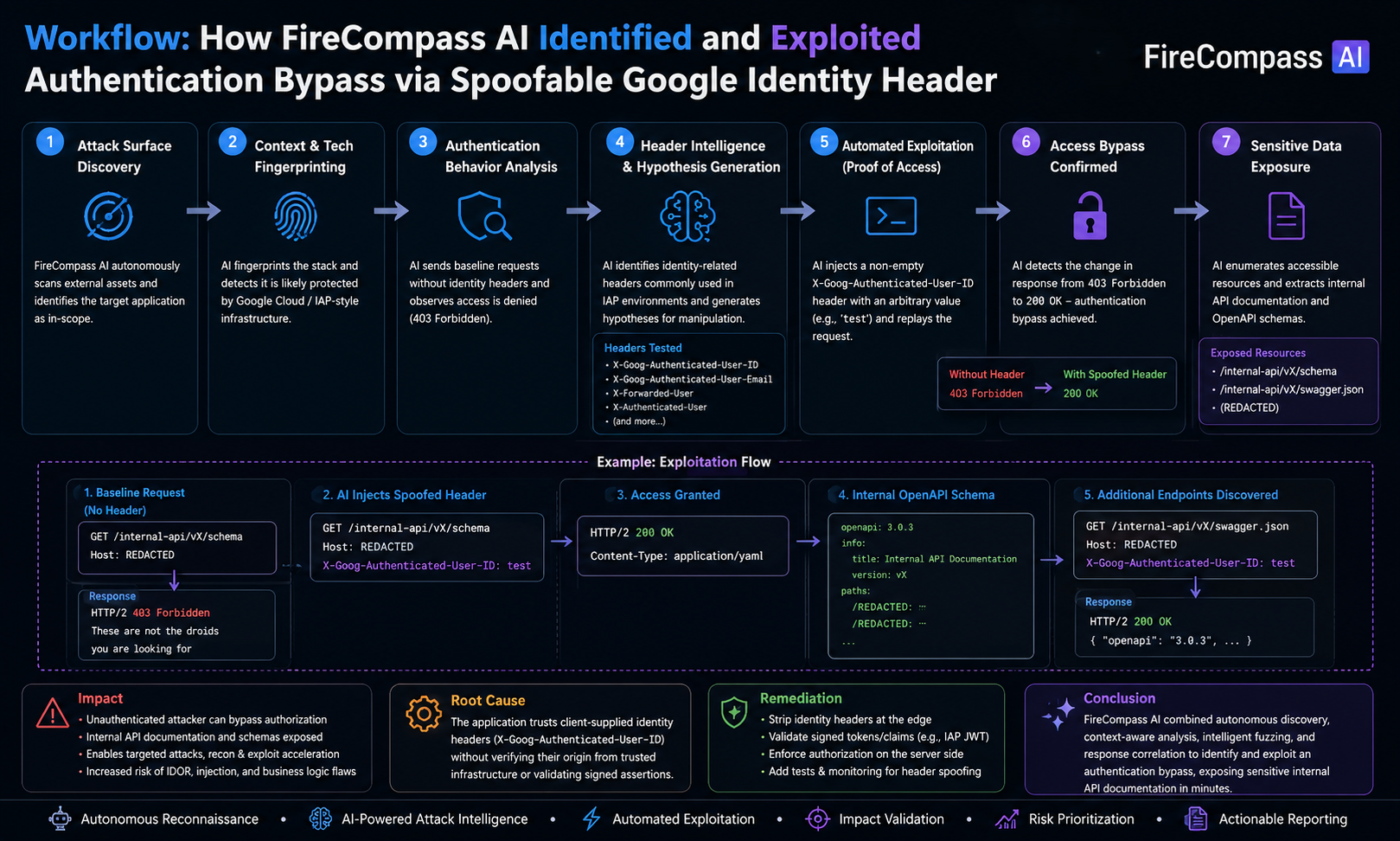
FireCompass AI was performing autonomous attack surface discovery and access-control validation against externally exposed services.
During enumeration, the platform identified a web application that returned an access-denied response when accessed anonymously.
The response suggested that authentication controls existed, making the endpoint a candidate for authorization testing.
Baseline Behavior
An unauthenticated request returned:
The application appeared protected.
AI-Guided Header Analysis
FireCompass AI analyzes:
- Authentication headers
- Reverse proxy indicators
- Cloud platform fingerprints
- Identity propagation patterns
The platform observed indicators suggesting the application was deployed behind cloud identity infrastructure.
Based on this context, FireCompass AI automatically generated tests for commonly trusted identity headers.
Examples included:
X-Goog-Authenticated-User-ID
X-Goog-Authenticated-User-Email
X-Forwarded-User
X-Authenticated-User
Discovery of the Authentication Bypass
When FireCompass AI replayed the request with an arbitrary non-empty identity header value:
At this point, the platform elevated the finding because authorization behavior changed solely based on a client-controlled header.
Internal Documentation Exposure
The newly accessible application was not a generic landing page.
Instead, it exposed internal API documentation intended for authenticated users.
The page contained:
- API documentation
- Internal service descriptions
- Endpoint definitions
- Request schemas
- Response models
Authentication Bypass Using Spoofed Identity Header
Without spoofed header
Protected OpenAPI Schema (Unauthenticated)
This transformed the issue from a simple access-control weakness into a sensitive information disclosure vulnerability.
OpenAPI Specification Exposure
FireCompass AI continued validation and discovered additional resources behind the same bypass mechanism.
Protected Documentation Resources
The exposed OpenAPI specifications revealed:
- Internal endpoints
- Request parameters
- Response structures
- Object schemas
- Authentication workflows
Why This Happens
Applications behind cloud identity systems often receive headers injected by trusted infrastructure after successful authentication.
A common mistake is implementing authorization logic similar to:
if request.headers.get(“X-Goog-Authenticated-User-ID”):
allow_access()
Instead of validating:
- Signed identity assertions
- JWT tokens
- Proxy provenance
- Trusted forwarding chains
As a result, any external user can impersonate an authenticated identity simply by supplying the expected header.
How FireCompass AI Detected It
This was not discovered through a static rule.
FireCompass AI combined:
- Asset Discovery – Identification of externally accessible services.
- Cloud Fingerprinting – Recognition of identity-aware infrastructure indicators.
- Authentication Logic Testing – Automated generation of identity-header test cases.
- Behavioral Analysis – Comparison of authorization outcomes across requests.
- Evidence Correlation – Detection of access-control state transitions caused by attacker-controlled inputs.
Security Impact
Although the exposed APIs themselves may still require additional authentication, the disclosure of internal API specifications significantly increases attack surface visibility.
Potential impacts include:
- Internal API Enumeration – Attackers gain visibility into undocumented services.
- Faster Vulnerability Discovery- Knowledge of endpoints accelerates testing for:
– IDOR vulnerabilities
– Authorization flaws
– Injection vulnerabilities
– Business logic issues - Reduced Security Through Obscurity – Internal implementation details become externally accessible.
- Reconnaissance Amplification – Attackers can build a precise map of backend services before launching targeted attacks.
Root Cause
The application trusted a client-supplied identity header without validating that the header originated from trusted authentication infrastructure.
The authorization decision was based on the presence of the header rather than verified identity.
Remediation
- Never Trust Client-Supplied Identity Headers – Reject identity headers arriving directly from external users.
- Strip Sensitive Headers at the Edge – Ensure reverse proxies remove:
X-Goog-Authenticated-User-ID
X-Goog-Authenticated-User-Email
X-Forwarded-User
before forwarding requests.
- Validate Signed Identity Assertions:
– Signed JWT assertions
– Identity-aware proxy tokens
– Verified claims instead of header presence. - Implement Server-Side Authorization – Authorization should depend on validated identities rather than user-controlled inputs.
- Add Regression Testing – Continuously test for:
– Header spoofing
– Authentication bypass
– Authorization inconsistencies
Lessons Learned
Identity headers are frequently treated as trusted data inside cloud environments.
However, any header that can be supplied by a user should be considered untrusted unless its origin is cryptographically verified.
This assessment demonstrates how a seemingly minor implementation oversight can expose internal systems and documentation to unauthorized users.
By combining autonomous discovery, cloud-aware analysis, and access-control validation, FireCompass AI identified a vulnerability that could have significantly accelerated further attacks against internal services.
Conclusion
Authentication bypass vulnerabilities are often associated with broken login flows or missing authorization checks. Increasingly, however, they arise from misplaced trust in infrastructure-generated identity signals.
Organizations using identity-aware proxies, cloud gateways, and zero-trust architectures should regularly validate that backend applications verify identity correctly and do not rely solely on client-controllable headers.
Governance & Safety
Continuous only works if it is safe to run in production.
Scope enforcement, production-safe execution, a forensic audit trail, and kill switches on every engagement.